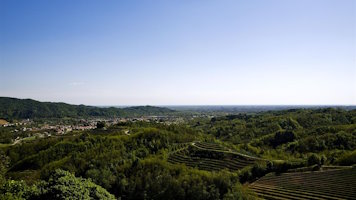
Forame consists of several hamlets arranged on the terraces of the two banks of the Malina stream: Borgo Ponte, Minins, Pradaroncs, Degano, Matteus, Salandri, Scoverz and Bombardier.
The name Forame derives from "foramen" (inner cave); in Slovenian, the area is called Malina, after the stream of the same name. First mentioned in documents from 1296, the area came under the lordship of the Attimis family in the 16th century. In the built environment, some characteristic rural buildings can be recognized, arranged in a line or isolated: two-story houses with an upper granary, external wooden balconies on the south façade, stone walls exposed or plastered with stone-framed openings.
Borgo Salandri still features some noteworthy rural architecture, in addition to a 19th-century mill by the river bank.
Borgo Pradaroncs is a typical piedmont village, with a row of isolated rural buildings arranged on the terraces, such as Casa Binutti, built around 1700 on pre-existing structures as a guardhouse for the bridge over the Malina: originally owned by the Attimis counts, later a barracks for the Finance Guard until the First World War, and currently used as a residence and home to the Fossil Museum. Spread over three and partly four floors, with plastered stone walls and stone-framed doors and windows, it has interesting stone architectural elements such as portals, columns and stairs on the façades.

Matteus Village
ph. Giorgio Bianchi, Archive MCC

Pradaroncs Village
ph. Giorgio Bianchi, Archive MCC

House in Salandri
ph. Giorgio Bianchi, Archive MCC

ph. Giorgio Bianchi, Archive MCC