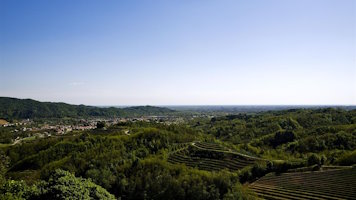
Among the initial elevations of the southern
Julian Prealps between Cividale and Povoletto, the rounded ridge of Mount Noas (620 meters above sea level) stands out, continuing southward with Mount Forcis (559 meters above sea level). The elevation, bordered to the west by the narrow valley of the Chirò stream, is covered by forest formations, with thermophilous broad-leaved trees (black hornbeam, manna ash, and downy oak) on the southern and eastern slopes, and mesophilous trees (beech, greater ash, wild lime, and hornbeam) on the western slope. The vast summit area, marked by the characteristic (karst) rounded funnel-shaped depressions called dolines (sinkholes), once hosting extensive meadows and pastures, is now almost completely reclaimed by the forest.
The vegetation alternates between open spaces, stretches of closed forest, and newly formed thickets, featuring aspen, black poplar, birch, and hazel. Near the summit are the Case Noas, which were used until a few years ago as temporary settlements for livestock activities. The forest track continues south towards Mount Forcis, then turns northeast until it reaches the Maria spring (535 meters above sea level), whose waters flow into the Chirò stream near Torreano.