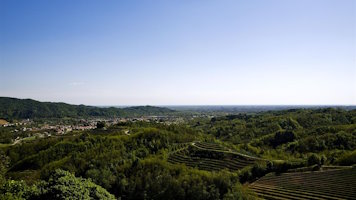
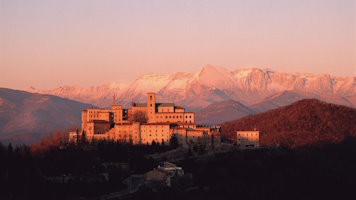
In the 1950s, the village (from the ancient toponym “Karnica,” which in the Po’nasin language means “valley” or “basin”) had a small number of inhabitants. Located near Mount Cella, it is arranged like an amphitheater on the slope. The locality is mentioned in the 13th century as a fiefdom of the Savorgnan family; during the Venetian era (15th-16th centuries), it was administered by the Brazzà Cergneu family, who maintained it until the 18th century. The buildings are characterized by wooden balconies and loggias: near the church there is a stone house, which rises three stories plus the granary; on the façade, a system of stone pillars stand out, with capital brackets at each floor, supporting the wooden beams that hold the racks of the loggias rest. Another building to the east has a load-bearing wooden frame on the façade, which supports the first-floor loggia with a rack and a large passage in correspondence with the barn. Similar to Carnic models is the stone building with a gable roof and portico, located in the western part of the village: the columns of the portico with an octagonal base support three stone arches with protruding keystones, and the symmetrical upper floor openings have stone frames. Mountain biking enthusiasts can explore the dirt road that climbs through the forest and emerges in the village, where they can visit the cave where significant territorial research is conducted.