[5th-6th century (?); 13th-18th century]
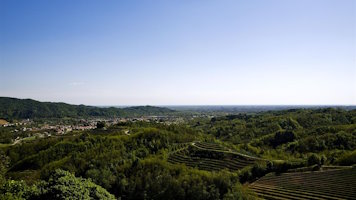
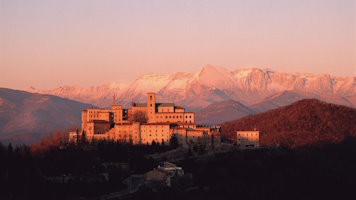
The hill, located west of the town center, houses the remains of Prampero Castle and the small castle church of Santa Margherita.
The castle has very ancient origins; according to scholars. A watchtower already existed in the late antique period controlling the important road, of Roman origin, coming from Aquileia and heading towards Noricum, beyond the Alps.
The first document from 1225 mentions the transfer of the fiefdom from the Lords of Pramperg, a German family that arrived in Friuli around the 11th century, to the nobles of Gemona (their relatives), who took the surname of their residence fief, thus becoming Prampero and Ravistagno. During the 14th century, the Prampero family remained feudal lords. The Carnival Revolt of 1511, which saw the Strumieri (supporters of the Emperor) and the Zamberlani (supporters of the Serenissima) factions oppose each other, also involved the manor, which was semi-destroyed by a fire and, in the same year, by a disastrous earthquake. It was rebuilt between the 16th and 17th centuries with the addition of new structures: the Renaissance loggia, frescoed by disciples of Chiarottini, and a stone staircase. It was inhabited by descendants of the same family until the earthquake of 1976.
The original complex was composed of a series of buildings arranged around an inner courtyard, including the quadrangular tower (26 meters high), the residential domus developed over three floors, and the building with the Renaissance loggia.

ph. Giorgio Bianchi, Archive MCC

ph. Carlo Michelizza

ph. Carlo Michelizza

ph. Carlo Michelizza