loader
  • WHERE TO GO
    WHERE TO GO
    • Regions
      Discover the mountain Regions
      Thousand-year-old cultures, different linguistic strains, biodiversity and multifaceted territorial morphologies. Discover the peculiarities of the valleys, municipalities and areas of the mountains of Friuli Venezia Giulia
      Discover the mountain Regions
      Thousand-year-old cultures, different linguistic strains, biodiversity and multifaceted territorial morphologies. Discover the peculiarities of the valleys, municipalities and areas of the mountains of Friuli Venezia Giulia
      All the mountain regions
    • Ski resort
      Discover the Ski areas in Friuli Venezia Giulia
      Summer or Winter, it doesn’t matter: skiers, pedestrians, hikers, bicycle lovers or who simply loves to enjoy a panoramic view, but without getting tired, will find open Ski lifts all over the year in the ski areas of FVG
      Discover the Ski areas in Friuli Venezia Giulia
      Summer or Winter, it doesn’t matter: skiers, pedestrians, hikers, bicycle lovers or who simply loves to enjoy a panoramic view, but without getting tired, will find open Ski lifts all over the year in the ski areas of FVG
      All ski resorts

The valley and saddle of Creta Forata from the Siera refuge

Long distance hiking trailrecommended routeLong distance hiking trail  · Carnia
LogoFriuli Venezia Giulia
Responsible for this content
Friuli Venezia Giulia Verified partner 
  • Prime luci
    Prime luci
    Photo: © Piller Hoffer Manuel, © Piller Hoffer Manuel

Selected alternatives for you
    A fairly flat valley, limited to the south by the imposing north face of the Creta Forata, to the west by the more modest Creton di Tul, to the north by the long ridge of the Cresta del Pettine and some outliers of the Piccolo Siera.
    moderate
    Distance 2.8 km
    2:15 h
    552 m
    41 m
    2,125 m
    1,615 m
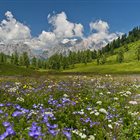
    To the eye of the visitor it seems solemn and severe for the basic nature of the features that distinguish it including a few isolated larches, beautiful alpine flowers, a high rock face (that of the Creta Forata in fact) and then so much solitude and a silence, rarely broken and then sedately by a few trippers. For hikers short on training the valley already represents a pretty goal, but it should be remembered that the route can be a segment of other paths covering a broader area (see itinerary ns. 18 19 & 20). The route proceeds, mostly at high altitude, in a very picturesque and panoramic setting, is not particularly strenuous bar the climb to the saddle (1915 m), at which, having arrived, it pays to go up all the way to the fork of the same name from where views stretch out towards the val Pesarina, the Razzo plateau, the mountains of Sauris and the distant Dolomites beyond the Piave. The path is not particularly difficult except for a short stretch between the refuge and Cima Dieci, where erosion that began at the turn of the century means the path requires periodic, partial restoration that, here and there, has collapsed or deteriorated (here hikers with little experience must be very careful and if possible proceed with the assistance of an experienced hiker). NB the stretch of trail carved into the rock is very exposed but the fixed equipment allows passage without problems (though a lanyard and carabiner are useful for novice hikers).
    Profile picture of Giovanni Borella
    Author
    Giovanni Borella
    LogoFriuli Venezia Giulia
    Responsible for this content
    Friuli Venezia Giulia  Verified partner 
    Difficulty
    moderate
    Overall difficulty
    moderate

    Derived from the technical difficulty and the stamina requirements.

    Experience
    Landscape
    Highest point
    2,125 m
    Lowest point
    1,615 m
    Best time of year
    Jan
    Feb
    Mar
    Apr
    May
    Jun
    Jul
    Aug
    Sep
    Oct
    Nov
    Dec

    Track types

    Show elevation profile

    Safety information

    Difficulty: E with a short stretch EE

    Tips and suggestions

    AVVERTENZE

    • Le informazioni sotto riportate non possono essere considerate sostitutive della presenza di una guida alpina professionista
    • La montagna è un ambiente meraviglioso ma non esente da rischi, va quindi avvicinato sempre con la massima prudenza
    • Nelle Avvertenze delle Guide dei Monti d’Italia C.A.I./T.C.I. si legge che la classificazione delle difficoltà “rimane essenzialmente indicativa e va considerata come tale”, trattandosi di un elemento soggettivo. Questo vale anche per gli itinerari proposti nel sito
    • La classificazione delle difficoltà e i tempi di percorrenza vanno riferiti ad un escursionista/alpinista di livello medio riguardo ad allenamento, esperienza, abilità, allenamento 
    • Nell’intraprendere un determinato percorso si valutino bene le difficoltà, le proprie capacità e il proprio grado di allenamento
    • Prima di affrontare un itinerario (che non sia una passeggiata di breve durata) è buona norma: 1) consultare il Dolomiti Meteo dell'Arpav, collegandosi al sito http://www.arpa.veneto.it o chiamando il numero 049 8239399 (Opzione 2). Il bollettino, a differenza dei bollettini meteo nazionali, offre una previsione locale piuttosto affidabile. 2) assumere informazioni presso l’Ufficio Turistico, la locale sezione del C.A.I., le guide alpine, i gestori dei rifugi. Infatti lo stato di percorribilità di un itinerario e il suo livello di difficoltà possono andare incontro a significative variazioni anche in uno spazio di tempo assai limitato a causa di eventi naturali (frane, condizioni meteo sfavorevoli) e/o di situazioni contingenti (deterioramento dei segnavia, delle attrezzature fisse, presenza di nevai residui, ecc.)
    • Il cellulare può offrire un’erronea sensazione di sicurezza, perché si deve tener presente che vi sono zone prive di copertura telefonica
    • Nel malaugurato caso di incidente, malore, impossibilità a proseguire, contattare solo e esclusivamente il SUEM 118

    Coordinates

    DD
    46.555956, 12.719915
    DMS
    46°33'21.4"N 12°43'11.7"E
    UTM
    33T 325226 5158346
    w3w 
    ///minimalist.king.bakes
    Get there by train, car, bike, or on foot!

    Book recommendation by the author

    © Tratto dalla Guida "Sappada, dai sentieri alle vette" di Giovanni Borella , edita dalla casa editrice CO.EL.

    Giovanni Borella Nato a Belluno, vi ha vissuto sino alle soglie dell'adolescenza. Si è successivamente trasferito a Padova, dove ancora risiede, frequentando la locale Università e conseguendo la laurea in Lettere Antiche che lo ha portato a esercitare l'insegnamento per qualche decennio. Escursionista prima, alpinista poi, ha compiuto numerose ascensioni sia nei più noti gruppi dolomitici sia in particolare sui monti di Sappada, che frequenta da moltissimi anni d'estate e d'inverno e dove ha anche aperto vie nuove e ripetuto altre in solitaria. Ha pubblicato tre guide: "Sui sentieri del sole" ed. Mediterranee 1995 in qualità di coautore, "Sappada, dai sentieri alle vette" editrice Co.El. 2002, "Dolomiti del Comelico" Linteditoriale 2010.

    Author’s map recommendations

    Carta Topografica Tabacco - Foglio 01 - Scala 1:25000

    Similar routes nearby

    • 17 MALGA GEU from the Siera refuge - Sappada
    • 16 CRETON DI TUL - Sappada
    • Cima Sappada - Calvi mountainhut
    • MADE TREKKING
    • 20 HIGH GEU PASS - Sappada
     These suggestions were generated by our system
    Difficulty
    moderate
    Overall difficulty
    moderate

    Derived from the technical difficulty and the stamina requirements.

    Distance
    2.8 km
    Duration
    2:15 h
    Ascent
    552 m
    Descent
    41 m
    Highest point
    2,125 m
    Lowest point
    1,615 m

    Statistics

    • Content
    • Show images Hide images
    Features
    2D 3D
    Maps and trails
    Nothing selected - click and drag in the elevation profile to zoom
    Distance
    Duration
    Ascent
    Descent
    Elevation profile