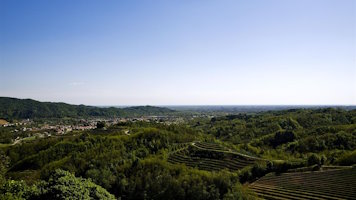
Attimis, first mentioned in 1106 when Bertoldo donated the castle to Corrado and Matilde of Moosburg, came under the jurisdiction of the steward of Tricesimo in 1211, and in 1645, the Attimis family obtained penal jurisdiction from the Venetians.
The town is made up of several villages: on one side of the Malina river are Centa, Pecolle or Castello, Villa, Pòcis, Campolongo, and Gravis; on the other side are Sopra or Strassoldo, and Sotto or Martinuzzi. They all feature terraced and courtyard rural buildings, two stories high with granaries, wooden balconies and racks, exposed or plastered stone walls with stone frames, and wooden roofs with tiles.
Centa village, centred around the Church of Saint Andrew, is bordered by the Attimis canal and showcases a row of 16th-century houses with balconies, featuring external stone and wooden staircases.
Pecolle village retains the remains of the Attimis counts' villa, in stone masonry with loggias, and an isolated stone portal leading to a mill.
In Campolongo, there is Via Nelle and Borc dai Vues. In Via Nelle 17th-century rural buildings with stone masonry form an architectural row with loggias, balconies, and external wooden staircases. In Borc dai Vues, there is a mill dating back to 1492 and at the head of a curved row, Casa Delfina (18th century), with plastered stone and a protruding fireplace; by the canal, there are 16th-century buildings with wooden balconies and external staircases, a fireplace, and a devotional fresco dated 1873.

ph. Giorgio Bianchi, Archive MCC

ph. Gorgio Bianchi, Archivio MCC

Delfina house
ph. Giorgio Bianchi, Archive MCC

ph. Giorgio Bianchi, Archive MCC