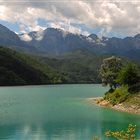
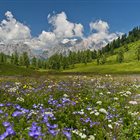
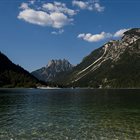
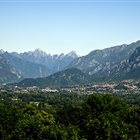
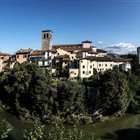
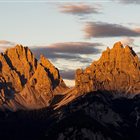
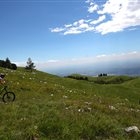
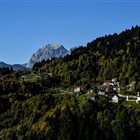
The route aims to showcase the evolution of the ancient Resian glaciers. At Sella Carnizza, traces of the last small glaciers that shaped the valley are preserved.
The route, quiet and away from traditional tourist circuits, runs among the mountains surrounding the southern part of Val Resia, crossing characteristic settlements and exclusive natural landscapes, leading the hiker to discover a section of the Julian Prealps with a unique character and remarkable environmental features.
The ancient glaciers: the protagonist of this route is the geomorphological evolution of the last 100,000 years, during which the great Würm glaciation left clear traces, unmistakably shaping the territory along which the ecomuseum itinerary develops.
To experience a complete experience about the uniqueness of the Resia valley, it is strongly recommended to visit the museums of Val Resia or to enjoy some typical dishes in one of the establishments located in Sella Carnizza.
The best period for this itinerary is undoubtedly autumn, thanks to the beech trees that turn warm shades.
Derived from the technical difficulty and the stamina requirements.
In case of injuries, the number to call is 112 NUE
Ticks are present throughout the Friuli Venezia-Giulia region; therefore, it is advisable to learn about prevention and protection techniques: Ticks information Friuli Venezia Giulia region
The route is not recommended after or during adverse weather conditions such as rain, snow, or during the hottest summer hours.
Mobile phone coverage is absent along almost the entire itinerary.
It is recommended to carry out all types of waste and to preserve the places crossed as best as possible.
Note that collecting plant species or parts thereof is prohibited within the Natural Park and may be subject to restrictions as per Regional Law 7/2009 in outside areas. The list of protected species can be consulted at this link.
Remember that within protected areas, dogs must be kept on a leash.
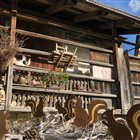
From Gniva to Lischiazze: the route starts from the secluded hamlet of Gniva (Njïwa), where the symbolic Gate marking the entrance to this itinerary is located, which will end in the Piazza of Sant'Anna di Carnizza. We travel along via Carnizza crossing the village, situated on a sunny plateau with the mighty mass of the Monti Musi in front, at the foot of which we are heading. Near the last houses, the road runs next to large rocks. These are huge erratic boulders brought here by the glacier that descended from the Musi. Careful observation near a curve, beyond the last house, shows a beautiful carved capercaillie on the largest of these boulders, a species found in the mountain forests of the Prealpi Giulie Park. After a short descent, we reach the junction with the paved road that leads up to the hamlet of Lischiazze, near the bridge over the Barman stream. We keep left and, after crossing the bridge, near an ancient mill (ruin), we start to climb again, soon arriving at Lischiazze (Liščaza) (30 minutes from the start).
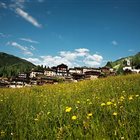
From Lischiazze to Sella Carnizza: crossing Lischiazze, attention is drawn to the rocky overhanging walls of the Musi rising powerfully towards the south. Near the end of the hamlet, the new building of the multifunctional center is visible, which occupies the site of the former alpine barracks controlling the Sella Carnizza pass, decommissioned in the '90s. The road gently rises again to the clearing where, on the right, a comfortable and well-marked forest track can lead us to visit the "Fontanone Barman" (detour), where there is an interpretative panel indicating the protected regional area of the Prealpi Giulie. Going straight, we encounter the Barman stream again and then start the real ascent. In summer, the walk is kept cool and pleasant by the shade of a dense beech forest that will accompany us up to 1085 m altitude at Sella Carnizza, which we will reach after about 4 km of walking (1.5 hours from Lischiazze). Shortly beyond the pass, the view opens onto a setting of bright meadows dotted with the characteristic stone buildings of the Stavoli Gnivizza, adding a bucolic touch to the mountain landscape. In about 20 minutes walking from the pass, we reach the little church of Sant'Anna (signposted on site), which represents the goal of this itinerary.
Public-transport-friendly
Bus
In Val Resia there are some local public transport bus lines. To know schedules and stops, view the pdf file at this link: click here or visit the TPL FVG website.
Train
The nearest useful station is Stazione Carnia, over 20 km from the itinerary starting point.
The hamlet of Gniva is easily reachable via the SP42. From SS13-Pontebbana, heading towards Tarvisio, turn right at Resiutta and follow signs for Gniva.
Gniva is also accessible from Tarcento, following the SR646 towards Uccea. At Uccea, turn left following the signs to Sella Carnizza and then continue on the same road passing the hamlet of Lischiazze until reaching the junction with SP42. From here, turn right and continue to Gniva.
NOTE: the Uccea-Sella Carnizza road is often subject to safety works. Before following these directions, check whether it is open.
Some free parking spaces are available along the village roads.
A suitable outfit for outdoor activities is recommended:
Localization
Derived from the technical difficulty and the stamina requirements.