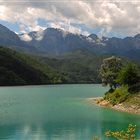
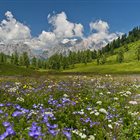
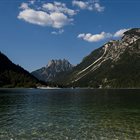
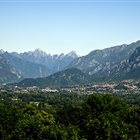
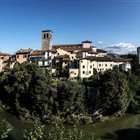
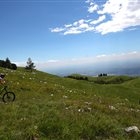
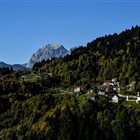
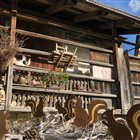
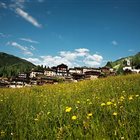
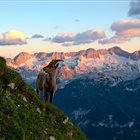
The route develops among the mountains that border the northern part of Val Resia, accompanying the hiker on a journey of discovery of the history and culture of this splendid valley through the typical buildings called stavoli.
The "Via degli Stavoli" is part of the thematic trails of the Val Resia Ecomuseum and offers the opportunity to learn about the Resian stavoli. These were genuine mountain villages with everything necessary to live self-sufficiently for several months. The route leads to Ruschis, which, due to the excellent state of conservation of the village and the very ancient sundials on its buildings, is one of the most interesting locations in the entire valley.
Until a few decades ago, when community life was closely tied to the rhythms of nature, these were authentic mountain villages where men and livestock moved during the summer season for traditional alpine pasture practices. In these environments, there was everything needed to live self-sufficiently until autumn arrived, when the cold forced people to return to the villages.
To have a complete experience of the uniqueness of Val Resia, it is highly recommended to visit the:
Or to enjoy some typical dishes at the local establishments in the valley.
Derived from the technical difficulty and the stamina requirements.
In case of injuries, the number to call is 112 NUE
Ticks are present throughout the Friuli Venezia Giulia territory, so it is advisable to learn about prevention and protection techniques: Information on ticks by the FVG Region
The route is not recommended after and during adverse weather conditions such as rain, snow, and during the hottest summer hours.
It is recommended to take home all types of waste and preserve the places crossed as well as possible.
It is reminded that the collection of plant species or parts thereof is prohibited inside the Natural Park and may be subject to restrictions as per regional law 7/2009 in surrounding areas. The list of protected species can be consulted at this link.
It is also reminded that dogs must be kept on a leash inside protected areas.
We leave San Giorgio at the height of the church, where a comfortable gravel road (preceded by a small Ecomuseum totem) will quickly lead us through meadows and cultivated fields. At the entrance to the path, note an ancient devotional crucifix dedicated to San Giorgio, the patron saint of the village. The sensations continue once the path is taken, which gently begins to climb the slope. Slowly the forest takes over; here, hidden among soft cushions of heather and bright trunks of black pine, are numerous jewels left to us by history, such as the cross in the rock near the Stulunčić stream and the so-called "traveller's spring." After crossing the wooden footbridge, we continue the ascent. Soon the forest will give way to a completely different environment, allowing us to proceed between narrow rocky walls characterized by evident rock weathering due to freezing and thawing. The black pine forest slowly gives way to the Scots pine just before the summit of the climb. Here, the vegetation cover will open up, allowing the gaze to run over the opposite side of the valley.
Arriving at the idyllic village of Ruschis, we immerse ourselves in the visit to this timeless place, which deserves to be discovered at a leisurely pace, getting lost among its small mountain pastures. Leaving behind the Stavoli Square, we follow the forest road and then leave it near a small path that plunges into a beautiful beech forest (CAI 631 trail mark). The long walk will pass by other old mountain pastures, then cross the gravel road again, proceeding on the southern side of Monte Plagna.
At the foot of Col Mezzodì, at another group of stavoli, we begin to descend in altitude following the ecomuseum signs. First, it is worth stopping to admire the panorama over the valley. Returning to the woods, the path will become relatively steep, so it is necessary to proceed with caution. In a succession of views over the valley, the route will descend to the center of San Giorgio.
Public-transport-friendly
Bus
In Val Resia, there are some local public transport bus lines. To find schedules and stops, view the PDF file at this link: click here or visit the TPL FVG website.
Train
The nearest useful station is Carnia Station, located more than 20km from the starting point of the route.
The hamlet of San Giorgio di Resia is conveniently reachable via the SP42. From the SS13-Pontebbana, heading towards Tarvisio, turn right at Resiutta and follow the signs for San Giorgio.
San Giorgio can also be reached from Tarcento by following the SR646 towards Uccea. At Uccea, turn left following signs to Sella Carnizza and then continue on the same road until passing the hamlet of Lischiazze and arriving at the intersection with SP42. From there, follow the signs to San Giorgio.
NOTE: the Uccea-Sella Carnizza road is often subject to safety works. Before following these directions, check if the road is open.
Some free parking is available along the streets of the village.
A suitable equipment for outdoor activities is recommended:
Localization
Derived from the technical difficulty and the stamina requirements.