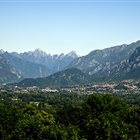
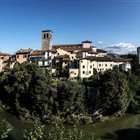
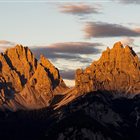
From the Park Visitor Center you reach the Bird Area and then follow the path which, uphill, leads to San Daniele. To the left of the small church, shortly, you reach a panoramic point (info panel) from which it is possible to observe from above the valley of the Susaibes stream (Geosite). The valley has a rocky aspect as it develops near a tectonic element (overthrust) that crosses the entire region and causes the reliefs located to the North (Corta, Castello and Raut mountains) to rise above the reliefs located to the South (Fara and Jouf mountains).
After returning to the small church, you descend towards the location Sott’Anzas (info panel) from where you access the bed of the Susaibes and the Geosite. Following the stream course upstream, you can closely observe the geological features of the Geosite: cataclastic rocks, fault mirrors, detrital thrust sheets…
Back at Sott’Anzas, you descend along the paved road and then take the path leading to the “scout base.” About two hundred meters beyond the house, along the course of the Alba stream (info panel), it is possible to observe the older Triassic Main Dolomite overthrust onto the younger Miocene Molasse.
Return towards Sott’Anzas along the same route and then follow the path running alongside the Susaibes and Alba streams up to the road bridge (start of the provincial road to Pala Barzana). Follow the road towards Andreis and then join the track leading to the abandoned village of Cordata (info panel).
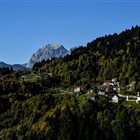
On the opposite side of the valley, you can observe the slopes of the Fara and Jouf mountains (to the South) characterized by their regularity (inclined planes). The stratification arrangement influenced the evolution of these slopes, formed by Cretaceous reef limestones, giving rise to these forms. The gentler morphologies found in the center of the valley are instead associated with the higher erodibility of the Paleocene Red Scaglia, the Eocene Flysch, and the Miocene Molasse. Some houses in Cordata are tilted due to landslide movements on the Flysch that occurred in the recent past (info panel). The route continues towards Pical and then follows the path that climbs the Ledron stream course where glacial deposits (info panel) and Flysch outcrops can be observed. After about 400 meters, you take a path on the right that climbs the slope and leads to the Andreis Visitor Center (starting point).