Challenging loop route, with ascent to the summits of Bivera and Clap Savon and passing the Casere Montemaggiore and Tragonia huts, in the Forni di Sopra Valley
The proposed hike is a long high-altitude ride reaching from the Razzo plateau the summits of Mounts Bivera and Clap Savon, returning to the start point through Malga Montemaggiore and Tragonia with interesting variants of Forcella Forada and Forca Rossa. The full route requires excellent training due to the large elevation gain.
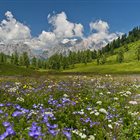
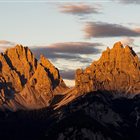
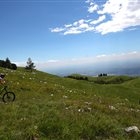
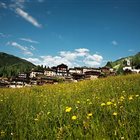
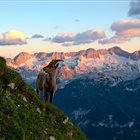
The gently sloping pastures at the start are followed by bare scree slopes and the fascinating summits of Bivera and Clap Savon.
The descent to Casera Montemaggiore and ascent to Forcella Forada are natural highlights, as is the beautiful small valley of Rio Tolina towards Malga Tragonia.
With some effort, the final climb brings you into view of rocky Tiarfin, from where you descend a steep scree slope and then into forest back to the starting point.
Possibility to split the itinerary by staying overnight at Malga Tragonia which also offers a restaurant service.
Derived from the technical difficulty and the stamina requirements.
The ridge section from the Bivera saddle to the summit of Clap Savon has some exposed sections but without mountaineering difficulty and facilitated by the presence of a fixed rope. The section from Bivera saddle to Cjansaveit saddle does not follow a formal CAI trail but the tracks are nonetheless very clear.
The descent from Cjansaveit saddle to the Malga Montemaggiore, as well as the ascent to the Forada saddle, require attention to correctly identify the sometimes grassy paths (CAI trails 210 and 211a).
The descent from Tiarfin saddle to Casera Razzo is initially steep on scree then continues on a path sometimes rich with vegetation (CAI 208).
If necessary, the route can be shortened by returning to Casera Razzo either at Cjansaveit saddle or at Croce di Tragonia saddle.
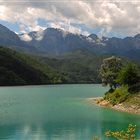
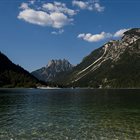
From Casera Razzo, passing near the entrance, continue on a dirt road heading SE passing near Lake Razzo. In view of Casera Mediana, stay on the right road reaching Casera Cjansaveit without any chance of error. Beyond the hut, the CAI 212 trail goes towards the northern slope of Bivera climbing its scree towards the saddle visible at the end. From the saddle, the detour to the summit takes place to the left, clearly visible.
Back at the saddle, continue to the right on clear tracks near the ridge crest with some exposed sections reaching the summit of Clap Savon with its cross.
From the cross, a long descent begins on the NW scree side, losing altitude on clear tracks down to the meadows near the Cjansaveit saddle from where you descend further to the left into a small valley that leads to Casera Montemaggiore (CAI 210 trail).
Before the hut, to the right and uphill again, the CAI 211a trail climbs among the dwarf pines to the exposed Forada saddle, skirting a rock wall and gaining the head of the Rio Tolina valley. The descent is clear and continuing along the trail, you reach the pastures of Malga Tragonia.
From Tragonia, again to the right and uphill, climb to the Croce di Tragonia saddle (CAI 209) and just before it, turn left towards the scree of Forca Rossa. Upon reaching the summit, after a short descent in the small valley, take the right on the CAI 208 trail which descends steeply the scree on the north side continuing along the same trail until the road that connects Casera Razzo to Rifugio Tenente Fabbro.
A short stretch of asphalt to the right returns you to the starting point.
None.
Casera Razzo is reachable from Val Degano via SS 465 of Val Pesarina passing the fractions of Prato Carnico and continuing to Forcella Lavardet. From here, with SP619, you reach the parking a few kilometers from the hut.
From Laggio di Cadore, climbing the SP 619 for a long way, you first pass near Sella di Ciampigotto and shortly after reach the mentioned parking lot.
Large roadside parking near the hut.
Hiking map 1:25000, Tabacco Publishing House, no. 02 Forni di Sopra - Ampezzo - Sauris - Val Tagliamento
Normal hiking equipment.
Localization
Derived from the technical difficulty and the stamina requirements.