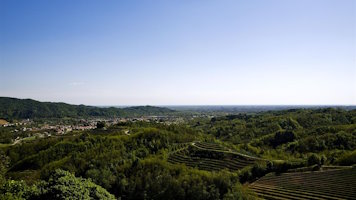
The small village is built on both sides of the stream joint by a single arch bridge connecting the road to the small square, where lies a fountain with an 1891 stone wash basin. Stremiz, first mentioned in 1294 belonged to the jurisdiction of the Cucagna family from the 13th century. The village has a few very interesting buildings from an environmental point of view, that are grouped along the road axes and the small square. The buildings are two or three stories high, with a granary, wooden balconies, exposed stone masonry squared at the corners, and stone-framed openings and portals. At the start of the village, on a 19th-century house there is an ancon depicting the Holy Family, dating back to the early 20th century. A two-storey building in exposed stone is adorned with a stone architraved portal with a bas-relief of a spiral snake in key and a lateral mask, dated 1839. An opening in the inner courtyard leads to the fogolâr structure, separated from the other rooms with two monolithic stone columns; a stone sink is built into an arched niche on one wall. Three of four grain mills once present remain, powered by the water from the canals from the Grivò stream; near the Stremiz bridge, there is a milling structure that is not easily accessible. Towards the source of the stream, there are two other mills dating back to the 18th and 19th centuries, with falls and gates used to regulate the flow of water. Nearby there is an arched stone bridge of probable Roman origin.

ph. Giacomo Toffoletti, Archive Comune di Faedis

ph. Giacomo Toffoletti, Archive Comune di Faedis

ph. Giacomo Toffoletti, Archive Comune di Faedis

ph. Giacomo Toffoletti, Archive Comune di Faedis